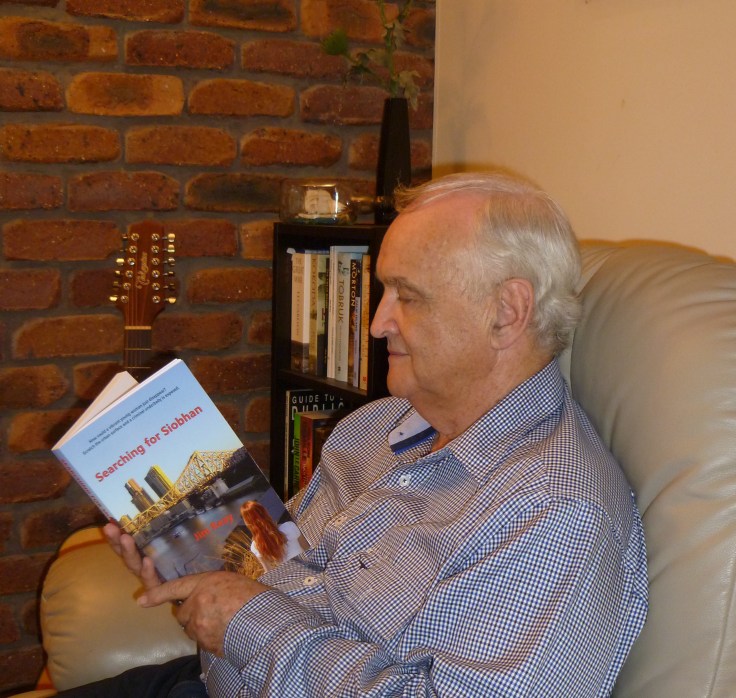
Searching for Siobhan is available, nationally and internationally, wholesale or retail, after 30 March 2016 from Rams Skull Press at RRP $28 AUD plus postage or from the author, from 14 March, when you meet him.
Searching for Siobhan is available, nationally and internationally, wholesale or retail, after 30 March 2016 from Rams Skull Press at RRP $28 AUD plus postage or from the author, from 14 March, when you meet him.
Robin Hood took from the rich and gave to the poor. It became the stuff of legend, books  and movies. But it was a reaction to the taxation tactics of King John and the Sheriff of Nottingham. Robin was just trying to be equitable – to help people who were being treated unfairly and had no power to resist. King John made himself so disliked by his own barons that they revolted and forced him to accept the Magna Carta – which was a guarantee that even kings had to abide by the law, that no-one could lose liberty without fair trial and that property couldn’t be taken away randomly or unjustly.
Some of the principles, distilled from Magna Carta, have become part of national constitutions and common law over the centuries. It is about the right to life, liberty and fairness before the law. It also led eventually to representative government to develop the laws (Chapter 14, Magna Carta) rather than it be by the divine right of kings or the church. Although, in Britain, it took a civil war and the execution of a king to finally establish what has evolved into the current Houses of Parliament and a democratic process.
Governments need to collect revenue to pay for community services. Equity suggests that tax contribution should be pro rata – both in the capacity to pay and in the benefit received from doing business in the community. That there should be no taxation without representation was derived from a Magna Carta principle. We are represented by our politicians – who may be influenced by people expressing their opinions; lobbying.
The bald arithmetic of revenue collection would suggest that our country’s taxation planners should start with a blank sheet – no tax-free concessions – and add up the grand total of personal and corporate tax. Essentially, if income is made in this country, then the correct rate of taxation is to be paid in this country. The lawmakers make the laws. We elect them to parliament. The rationale for many of the tax concessions comes from lobbying decades ago. Are those rationales still applicable? Given Australia’s extensive history of tax avoidance and loophole ridden tax legislation(quote, VI, section 4, 228), do governments have the social capital to take such a dramatic challenge to the people? Justify your tax-free status with the pub test, for starters
Without concessions, incentive payments, lurks and perks, the country might well have much more revenue than its liabilities for services. (Do the sums, yourself.) Only then, should the planners consider if any concessions are appropriate. Perhaps, the historical tax breaks might no longer be deemed worthy – such exemptions as for global corporations, parliamentary allowances, charities, churches, schools, farmers, miners, superannuation interest, negative gearing, all capital gains etc. Surely the question at least needs to be asked and the cases justified, in the current context. Tax minimisation has become its own industry. The more concessions that are given, the more scope there is for inequity and rorting – because those who have the means will engage in orchestrated lobbying. Without the lobbying of vested interests – it is just arithmetic! Don’t complicate it! Remember Robin Hood and Magna Carta. Just because that is the way it has been, doesn’t mean that is the way it must always be.
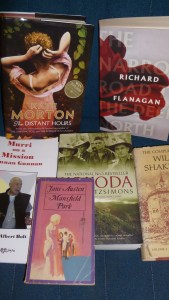 The society of past generations is shown graphically through the work of writers. Mark Twain, Jane Austen, Charles Dickens, Victor Hugo, Robert Louis Stevenson, H Rider Haggard, Alexandre Dumas to name a few.
Who could read Jane Austen’s Mansfield Park without living that society through eyes of Fanny Price, seeing the hypocrisy of social sham with the implication that it was built on the slave trade? My good friend, Uncle Albert Holt, tells his real-life story of growing up on Queensland’s Cherbourg Aboriginal Mission in Murri on a Mission, Gunnan Gunnan. It is a story of the poor fellow, of sorrow (Gunnan, Gunnan) but it is told with optimism; with the sense of resilience and humour which has seen Aboriginal people successfully through the oppression of the Act.
Contemporary Queensland novelist, Kate Morton, researches her history so well that she can even make a building (Milderhurst Castle) into a character which draws the reader into the thinking of that era. Peter FitzSimons, in Kokoda, has listened to the people who were actually there and has the talent to build a World War II experience into the sensations of heat, damp, cloying air, fear, mateship and anger; which are coupled with extraordinary physical and mental tenacity. Richard Flanagan’s award-winning The Narrow Road to the Deep North is again influenced by people Flanagan has interviewed, not least his father who was on the Thai-Burma Railway. But Flanagan lifts the reader into a higher level than just an experience of the sights, sound, smells and oppression of that experience. Rather, he tells his fictional tale about frailities, moral decisions and the social expectations of an era – with messages for this era.
Perhaps, the greatest social writing of Western civilisation comes through the works attributed to William Shakespeare. Irrespective of the debates about authorship, the quality of the plays and poems takes the audience and reader into the old world of Verona, the mental torment of the Danish prince, Hamlet, the social duplicity in Macbeth and the witty fun of Midsummer Night’s Dream. His insights are extraordinary, which is why the works have stood the test of time.
The difference between writing and movies is that the reader can mix personal experience and imagination, with the words, to live the story. A movie director chooses the visual images to channel a more restricted point of view – and in a short time-slot.
 Sean Connery, when being given a lifetime award for his acting career, said it wasn’t the James Bond role that gave him his big break, it was learning to read and finding public libraries.
Read away! Visit a library. Transport yourself away from the routine of daily life. Enjoy.
As with many aspects of life, the secret to having your dream published is to surround yourself with talented people.
Patrice Shaw is an astute editor of fiction. Kirsty Ogden is a fine graphic designer with years of experience in the publishing industry. Together, they have helped bring some of my books to fruition
Deb and Dave Edwards of Rams Skull Press are my publishers. They are honest country people who gave me my start, as they have done for many others, and printed my first book, Catching Legends. They have a niche business, primarily publishing the work of Dave’s father, the late Ron Edwards OAM. They now provide me with the ISBN, Catalogue in Publication, encouragement and the distribution network to reach retailers and wholesalers worldwide. We use small print-on-demand runs. The costs stay manageable.
My blog website at http://www.jimreaywriter.net , and the links from the websites of the others in the process, provide the word of mouth and Internet presence.
Check out the links, find the talented people that suit you and make a start. No pain!
The Tasmanian Devil is a voracious carnivore. It eats prey to survive. The prey has little choice against such a predator. But most humans do have a choice in life – decisions to be made.  Few people die wishing that they had spent more time at work. Aspirational mantras about the virtue of honest toil or hard work is the way to salvation are part of the same power culture which suggested that idle hands are the Devil’s workshop. Exhausted powerless toilers were presumably too tired to think of other ways, or to challenge the status quo. Meanwhile, those who were born to make the rules had plenty time for idleness. Not for them the hours of back-breaking work. Rather, they could engage in social pastimes of cultural or cerebral skill; debating, law making, networking, travel and exclusive clubs – while spruiking about their sterling selfless service to society.
That is the nature of the social orders such as feudalism, the caste system, the slave trade or, in more modern times, the class system in Australia, pyramid selling, charismatic cults or some international corporations. Know your place! That is the great Con. The few are using the many as pawns in a huge chess game. (Read The Chess Board)
Leaders can only lead when others will follow – the corollary of born to lead is born to follow. There is no problem with different roles in life as long as they are seen for what they are. Being educated and free to think for yourself are the keys to being aware of the world around and how it works. Wide reading and critical listening are great assets.
Are all people born equal? Clearly, they are not – not in the real world, rather than the aspirational world. There are huge disparities. The powerful maintain their power by fear or peddling hope or manipulating representative processes to their advantage. But the old systems are falling apart. The old economic models no longer work for a world approaching 8 billion people, with ecosystems straining. New sustainable economic models are emerging – new paradigms. But change doesn’t come easily to those who would stand to lose a comfortable lifestyle and a hold on power, by changing.
Continuing to cling to the belief that only free markets and nation states will resolve our current dilemmas is naïve. We need to recognise reality as it is – not as it once was. With the right political, legal and economic structures and institutions in place, the convergence of technologies can promise meaningful work, leisure time, prosperity and freedom for all – quote.
The imbalance needs to be redressed by, at least, flagging the problems and the solutions to those who make the rules. On the other hand, the Bourbon French King Louis XVI and the Russian Romanovs didn’t see it coming either. Nor did many others who didn’t understand equity – or that power manipulated by an elite rarely lasts, in the modern era. It is less painful if it is done by honey rather than vinegar! Check your history. Do your own research! Am I conning you?
None of us had a choice about when we were born, or where or to whom. So it takes a peculiar arrogance to justify thinking of people as superior or inferior based on the lottery of life. It was not the ‘stork’ that caused the problem.

While the rhetoric is saying there has never been a more exciting time to be an Australian, there are clearly serious issues which are being avoided. The sales pitch is to sell dreams while ignoring the elephants in the room. General David Morrison tactfully called some of it in his 2016 Australian of the Year acceptance speech. Stan Grant flagged the challenges for the Indigenous population. There is a huge difference between the language of aspiration, of hope, of wishes and the language of what is actually happening in our world at the moment. (See earlier blog ‘Is morality absolute?’)
The major elephant is: we are approaching 8 billion people on the planet and yet the economic models of the colonial era have not changed. There are 60 million people displaced in the world (more than twice the population of Australia) with nowhere for them to fit. Why is there no international dialogue about the exponential growth of population? There is a UN Declaration about Human Rights. Where is the UN Declaration about Human Responsibilities? Does one exclude the other? Surely not?
It will take a cultural or attitude change (preferably before the change is thrust upon us), but the strategies have been around for decades. They are such as: provide government financial incentives for small families rather than the reverse, have contraception readily available, give education for women so that they can have a choice or a mix of roles in the family and society.
In some societies, women have no choices. They are often in abject poverty or tied into cultural belief systems without access to alternative ideas or other ways. Some are dominated, subjugated or enslaved. But, where choice is available, the predictions are for a slowing of population growth.
Then we have to address the next elephant – the archaic economic models based on indefinite growth, plundering raw resources, favouring global corporations and fostering an ever-expanding consumer market. The models of previous centuries do not deal in self-sustaining strategies or employment roles which serve rather than exploit the community. It is possible to construct an ecological economic model where all the component parts stay in balance – but it does need population growth to be curtailed – along with self-interested greed. Settle for sufficiency and the cerebral leisure pursuits for which mankind is admirably suited.
Do your own research. This is not rocket science.
 Film actor Harrison Ford said recently on Australian television: Nature will take care of itself — nature doesn’t need people, people need nature to survive. The planet will be OK, there just won’t be any damn people on it.
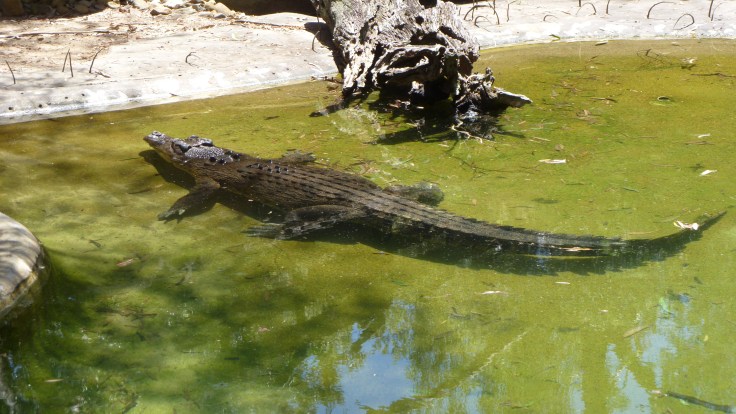
Whilst Ford might not be the fount of all knowledge, he does raise an interesting perspective about where our current civilisation fits into the history of the Earth, let alone mankind. The dinosaurs disappeared in the Cretaceous Period, some 65 million years ago, although some descendants like the saltwater crocodile (above) might have survived. Dinosaur fossils appear regularly in eroded layers of the Earth but they were just a blip in geological time. Man is an even smaller blip.
Even within human history our present era is still a blip. We may have over 7 billion people on the planet. We may think ourselves to be extraordinarily important, technologically advanced and with the ability to transform nature to our needs. But at least 60 million people are currently displaced, with nowhere left to flee. Our impact on the planet is putting all the ecosystems under strain.
At what point, do we face up to responsibilities as well as rights, as well as self-interest? Will we wait too long and become another layer in the history of the planet? Look back at just some of the mighty abandoned civilisations of their time, taken over by rainforest or desert. The Chaco, Angkor Wat, Kushan Empire, Aztecs, Great Zimbabwe, Incas and the old Amazon civilisations are just a few. Another layer in history? Check it yourself!
 No! It is a serious question – not a laugh!
Bertrand Russell, in On Education in 1926 (p127), wrote: A truly robust morality can only be strengthened by the fullest knowledge of what really happens in the world. Russell was a Nobel laureate for literature as well as being a professor of mathematics and philosophy. In essence, he challenged many of the irrefutable assumptions of society which to him appeared to be accepted because that was the way it had always been.
The UN Declaration of Human Rights (1948) seems to be one of those current unchallengeable notions. So, is it absolute? It takes much of its philosophical authority from the US Declaration of Independence (1776) and the French Rights of Man (1789). Both of those documents drew on the ideas of the Enlightenment, from thinkers like John Locke, Rousseau and Voltaire.
They lived in the 17th and 18th centuries when the population of the planet was less than 1 billion people, in a time of institutionalised slavery, child labour, minimal education for the majority, when many women were seen as possessions whose roles were domestic and to rear children. A lot has changed in the world – mainly with the population now well over 7 billion and heading towards 8 billion within ten years. Some progress has been made toward equality, although the lack of many rights continues with the slavery of poverty, huge economic disparity across the world, racism and sexism … to name a few.
The UN Declaration of Human Rights is very light on responsibilities, particularly the requirements on those in power, those who control the wealth, those who can make a difference through their decision making.
Is it time to look beyond the blind aspirations, to note what is actually happening in our world and to question whether or not our moral assumptions need to be recalibrated in the present situation? Are there social responsibilities to be considered? Is there a role for considering context? Or, is our version of morality absolute? (See previous blogs)
Just asking! Feel free to reply on jr71@outlook.com.au on the Contact page.
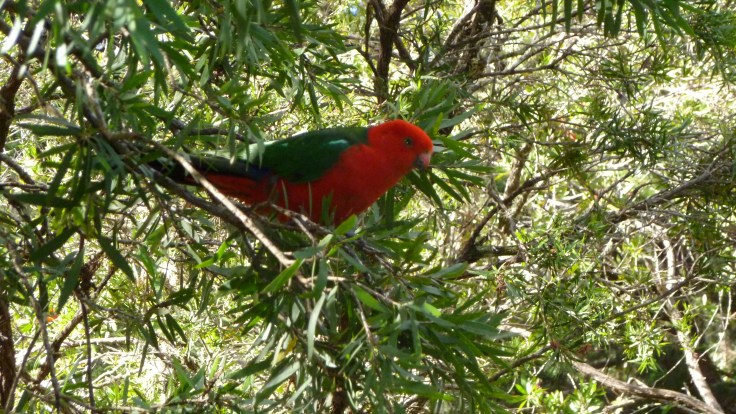 Beneath the striking feathers of the King Parrot is a very intelligent caring bird. There is more to it than appears at first glance – like many things in life; democracy perhaps.
Democracy is a word which might throw up notions of freedom, a say in the government, something to be valued – at least on the surface. For democracy to work well, it requires an educated population – people who have been exposed to a range of ideas, who have thought through the deeper issues of our generation and those past, who can think critically for themselves rather than just accepting what they are told, who can tell the difference between the spin of the manipulators and the truth. You get the drift. Where do the people get this wide knowledge, from multiple frames of reference?
Reading widely is a good start. Public libraries are reservoirs of the range of human thought and knowledge. In the library, a reader can absorb ideas across cultures, time scales and languages – and then form an independent opinion. The reader can learn to understand other points of view, to walk in another person’s experiences, to reason through what might be good or bad, or what might be wise or stupid.
The difference between groupthink and democracy is that the first group mindlessly or reluctantly follows the herd, whereas the voters in a democracy have the responsibility of a vote and the duty to be well informed. They can decide for themselves. Thank the librarians for assembling and providing such an opportunity to be a thinker.
Beneath the colourful plumage of the King Parrot is a very smart bird – not just a pretty bird. Look beyond initial appearances.
What do you think? Reply to jr71@outlook.com.au on the Contact tab
 Jim Reay Novels & Short Stories
